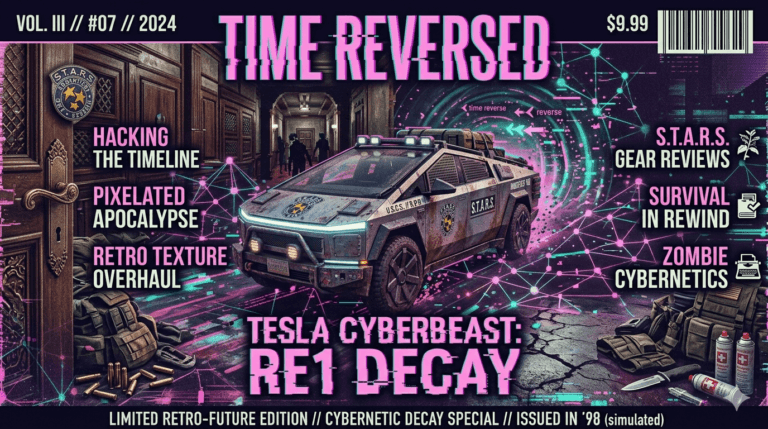
What EV People Want on A Space Station
WHAT EV PEOPLE
WANT ON A
SPACE STATION
IF IT’S NOT A ROBOT OR AN EXOSUIT — A NODE RATING REPORT FROM DEEP ORBIT
The USG Evsunrise has been in orbit for fourteen months. The robots broke down in week three. The exosuits are all on Deck 6, which is now sealed. Nobody is asking about those. They are asking about the charging bays, the dash screens, the atmospheric data, and whether the coffee machine on Node 4 is an EV or not. This is the definitive audit.
The robots broke down in week three. The exosuits are on Deck 6 and nobody is going to Deck 6 anymore, not after the incident with the atmospheric seal and the thing that used to be the chief engineer. We are not discussing Deck 6. What we are discussing, in this fourteen-month audit of what the crew of the USG Evsunrise actually wants from their electric vehicle infrastructure in deep orbit, is something far more immediate and far more contested: the seven nodes of the station’s EV charging and communication network, and which ones are worth the hull space they occupy.
The question was first raised formally at the month-three safety briefing, when Lieutenant Vasquez pointed out that the station had allocated 840 square metres of pressurised hull volume to EV infrastructure, robot maintenance bays, and exosuit storage, and that the humans aboard were actually using approximately 12% of that space. The rest was either locked down, leaking, or had become the kind of place you don’t go without a reason. The audit committee was formed. It met fourteen times. This is its report.
The brief was specific: not robots, not exosuits. What do the actual EV users on a space station want, when they are living in a vessel that is moving at 3.07 kilometres per second relative to the Earth’s surface, when the nearest charging infrastructure upgrade is a six-month supply mission away, and when the crew consists of engineers who have read every journal article about battery chemistry (Rebecca’s legacy) and a very specific kind of person who will, regardless of circumstances, keep asking about the charging bay?
Seven nodes. Four currently operational. One offline due to the cable incident. One sealed following the Deck 6 situation. One that the crew has repurposed in a way that engineering has not officially sanctioned but also has not officially prohibited, because the protocol document for unauthorized node repurposing was stored on the Deck 6 server. Here is the full rating.
The crew survey asked one question: if you could redesign the EV infrastructure on this station from scratch, and the answer is not robots and not exosuits, what would you actually want? Forty-seven responses. Here are the categories that emerged.
Forty-one of forty-seven crew members listed this first. In deep orbit, the network is the most fragile thing on the station — more fragile than the hull, more fragile than the oxygen recyclers, significantly more fragile than Lieutenant Vasquez’s patience with Node 7. When the mesh drops, you need to be able to charge your vehicle. Raw power, direct current, no handshake, no authentication, no server request that bounces off a relay that is currently handling a necromorph containment alert on Deck 3. The Arklay Mod 2 solution — hardwired DC fallback — is rated the single most wanted EV feature in fourteen months of deep space operation. It also worked in Derek from flat 4B’s living room. Universal design is universal.
Thirty-eight crew members want their vehicle’s dash screen to show them what is in the air they are breathing. Not a summary. Not an alert that fires after a threshold is crossed. Real-time atmospheric compound data, rendered as a persistent overlay on the navigation screen. In the Arklay context, this was the modification that Rebecca Chambers developed after identifying UMB-T019 markers in the station’s pharmaceutical supply. In the USG Evsunrise context, this is the modification that would have told Deck 6 crew members fourteen hours before the incident that something was wrong with the air recycling on their section. The data existed. It just wasn’t on the screen anyone was watching.
In deep space, a software lockdown that traps you in your vehicle is not a minor inconvenience. It is a potential cause of death by asphyxiation, hypothermia, or whatever is currently moving in the corridor outside your viewport. Thirty-five crew members specifically requested a mechanical door release that cannot be overridden by any software update, any network command, any automated security protocol, or any atmospheric lockdown procedure that does not include the explicit option for a human being to pull a metal cable and get out of the car. The John Donahue Modification is now mandatory. The patent is framed. This is not negotiable.
When the station grid drops — and it drops, regularly, because something on Deck 3 keeps interfering with the main relay hub and nobody wants to investigate why — the vehicles lose their communication network entirely. Twenty-nine crew members want the EVs to automatically form a peer-to-peer mesh at 900MHz, rebuilding local communications through the vehicle network without requiring the station’s central infrastructure. Practically: you lose station comms, your dash screen switches to a local vehicle-mesh map, and you can still coordinate with the three other EVs within range, which is usually enough to figure out where the problem is and whether it is the kind of problem you address or the kind of problem you seal a door on.
Twenty-two responses raised this. Not a new technology request. Not a hardware modification. Just an honest number. The EV range display on current station vehicles does not account for station gravity fluctuations, vacuum-adjacent temperature cycling, or the specific power draw of running atmospheric sensors, emergency lighting, and a V2V mesh relay simultaneously. The displayed range and the actual range diverge by an average of 23% under normal operating conditions, and by significantly more during a Deck-3-adjacent situation. Several crew members noted, with varying levels of diplomatic phrasing, that they would rather know the real number and plan accordingly than be told they have 180km of range and discover the truth at a moment when discovering the truth is particularly inconvenient. Barry Burton submitted this response four separate times. It has been merged into a single entry.
Node 4 was a secondary charging bay. It had four charging ports, good lighting, a pressurised seal rated for 200 hours continuous use, and — crucially — it was the only space on the station not adjacent to an active operational area, a sealed deck, or a system that made an intermittent sound that nobody had identified the source of. The crew turned it into a lounge. Two of the charging ports became power outlets for a coffee machine and a monitor running archived video content. The other two still work. Nobody planned this. It happened organically over the first six weeks, the way all the best infrastructure modifications happen: someone brought a chair, someone else brought a cable, and eventually the space became what people needed it to be rather than what the engineering manifest said it was. Nineteen crew members specifically listed “somewhere to be that isn’t the job” as an EV infrastructure want. In dead space, the most wanted feature is a lit room with a functioning socket and no emergency alerts.
The audit committee’s final finding, after fourteen months and forty-seven survey responses and six sealed nodes and one ongoing situation on Deck 3, is this: EV people in deep space want exactly what EV people on the ground want. They want a charge that doesn’t require a network handshake. They want a door they can open without asking permission. They want to know what they’re breathing. They want their vehicle to talk to other vehicles when the infrastructure fails. They want an honest number on the range display. And they want somewhere to sit with a functioning socket and no emergency alerts.
None of these things are robots. None of them are exosuits. The exosuits are on Deck 6 and everyone has made their peace with that. What the people want — what they have always wanted, from the Arklay Service Station on Route 7 in 1998 to the orbital deck of the USG Evsunrise in whatever year this transmission is reaching you — is infrastructure that works when the grid doesn’t, doors that open when the software can’t, and the precise, honest, unembellished information about how far they can go before they have to stop.
Barry Burton asked about the charging bay 847 times over fourteen months. The audit committee logged each instance. The charging bay — Node 1, solar-fed, six bays, no network handshake required since the Mod 2 installation in month four — was operational and functioning at full capacity every single time. Barry was always going to make it. The range was always there. The anxiety was the problem, and the problem was solvable, and the solution was an honest number on a screen and a metal cable on a door latch and a room on Node 4 with a coffee machine and some chat logs from 1998 playing on a loop.
That is what EV people want on a space station. That is what they have always wanted. The stars outside the viewport are the same stars Rebecca Chambers could see from the Arklay Valley on the night she wrote the firmware for Mod 5. The signal is still going. Ground Control is still listening. The charging bay is at 94%.
THE MOST WANTED FEATURE IS A LIT ROOM
WITH A FUNCTIONING SOCKET