NO FUTURE!
RESCUE SERVICE
EV DASH GAME CATALOGUE
DATE: 2026.03.20
UNIT: ALPHA-7
CLEARANCE: AMBER
UMBRELLA: MONITORING
DEAD PIXELS
LIVE CURRENT
In the year that Apple closed its car programme in twelve minutes, that Ford cut the Lightning’s production by seventy-five percent, that Hertz set twenty thousand Teslas loose on the auction floor — someone, somewhere, was still playing a game on a dashboard screen. This is the S.T.A.R.S. Field Catalogue of that game. And the nine others.
The electric vehicle dash screen is a peculiar piece of real estate. Larger than a handheld console, smaller than a television. Permanently mounted in a place of quiet captivity — the parked car, the charging bay, the slow crawl through morning traffic. Game designers who understand this medium understand something the EV manufacturers did not: that the best games for constrained environments are not diminished games. They are games built for the specific poetry of constraint.
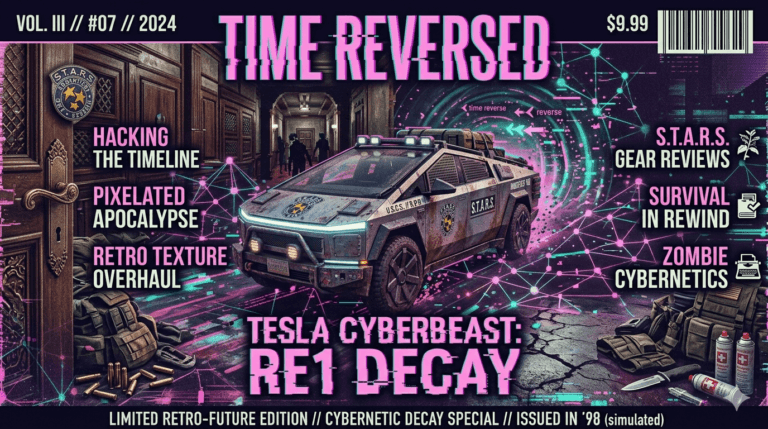
S.T.A.R.S. Unit Alpha-7 has catalogued ten pixel art titles recovered from decommissioned EV dashboards across the Raccoon City metropolitan area. Some predate the collapse. Some emerged after it. All of them know something about waiting, about limited energy, about the precise management of the range that remains.
ZERO RANGE PROTOCOL
Charge Runner is the game that should have shipped with every EV ever made. You play as a pixel sprite — a small glowing figure carrying a charge cable like a lance — navigating a scrolling city map in search of functional charging stations. Each pixel block of the city has been designed to mirror the actual anxiety of range management: you can see the destination, but the battery indicator in the corner keeps draining.
What separates Charge Runner from simple survival games is its urban design layer. The city itself is procedurally generated from real charging infrastructure data. Dead zones — areas with no stations — appear as crumbling grey pixel blocks. Station clusters appear as brief bright nodes. Playing it long enough and you begin to understand, viscerally, why the Hertz fleet failed: the infrastructure wasn’t there.
THE APPLE PROJECT
Titan Protocol is a resource management game in which you play as the director of a secret automotive programme at a technology company that shall remain unnamed. You have ten years. You have a thousand engineers. You have a budget large enough to fund a small nation’s infrastructure programme. You have one task: build the car.
The game is, of course, impossible. Every decision tree leads eventually to a meeting room. The meeting room has twelve seats. The game ends when all twelve seats are filled and the meeting timer counts down to zero. There are no cars in the ending cutscene. There is only a spreadsheet, and a line item marked AI, and a new loading screen.
THE FORD PRODUCTION GAME
Lightning Strike presents itself as a straightforward factory management game — you control a pixel assembly line, allocating workers, managing battery shipments, watching trucks roll off the production floor. The first thirty seconds are satisfying in the way all good factory games are satisfying. Things are being made. The counter climbs.
Then the demand curve begins to slide. Quietly at first — one fewer order per hour, then five, then twenty. The pixel workers keep showing up. The assembly line keeps running. But the lot fills with unsold trucks, rendered in amber pixels because the charging infrastructure to support them never materialised in the rural markets where F-150 buyers actually live. The game doesn’t punish you for this. It simply shows you the lot. Very full. Very amber.
A FISKER GAME
Ocean Drift is the most visually striking game in the catalogue. The Fisker Ocean’s solar-panel roof has been translated into a pixel art mechanic: your vehicle charges passively as you drive under open sky, loses charge under pixel clouds, and dies completely in the game’s many tunnels. The colour palette — deep ocean blues, amber coastline dust, hard white sun — is the best pixel art found on any EV dashboard in S.T.A.R.S. field operations to date.
The game was never officially released. It shipped pre-installed on Ocean demo units in 2023. When Fisker filed Chapter 11, the servers that would have handled updates went dark. The game remains on the dashboards of approximately five thousand Ocean vehicles worldwide, each copy slightly different, each drifting further from any intended final version. It is, inadvertently, the first great abandoned EV game.
THE HERTZ TETRIS
Fire Sale is a Tetris variant in which every falling piece is a small pixel car. The mechanics are inverted: clearing a row does not score points — it loses them, because each cleared row represents another vehicle sold below acquisition price. The goal is to build the tallest, most inefficient tower of unsold inventory while keeping the game running as long as possible. It is the most honest game about fleet management ever made.
The game was reportedly developed by a former Hertz operations analyst who was laid off during the 2024 restructuring. It spread across Hertz’s own fleet before the company finished selling it. There are documented cases of Hertz employees discovering Fire Sale running on vehicles they were attempting to auction. The irony was apparently not lost on anyone present.
THE PROMISE KEEPER
GM 2035 is a long-term strategy game built around a single promise: every vehicle you manufacture must be electric by the year 2035. You manage factory lines, lobby pixel politicians, deploy charging infrastructure, and attempt to shift consumer behaviour across fourteen years of simulated time. The pixel art is corporate-grey and weirdly beautiful in its bleakness.
The game has a known bug. In every playthrough, regardless of your actions, a patch arrives in Year 9 that rewrites the win condition. The 2035 deadline is replaced by a flexible target. The electric mandate becomes a preference. The game does not end — it simply continues, indefinitely, as a hybrid simulation. Developers have confirmed this is not a bug.
THE PEDESTRIAN PROBLEM
Cruise Control is the most uncomfortable game in the catalogue. You do not control the vehicle. The vehicle is autonomous. Your role is to monitor — to watch the pixel city scroll past, to observe the vehicle’s decisions, to note when it hesitates and when it proceeds with confidence. The game asks only one question: do you intervene?
Pedestrian sprites appear at random intervals. The autonomous system scores them, routes around them, adjusts speed. It is correct ninety-seven percent of the time. The remaining three percent is what the game is about. And the game does not tell you which frame you are in. It never tells you. You watch. The vehicle moves. The city continues.
PRE-ORDER SIMULATOR
Lordstown Shuffle is a role-playing game in which you play as the CEO of a startup electric truck company that has gone public via SPAC. Your pre-orders look extraordinary on the investor presentation. The pixel art factory looks operational. The Endurance truck prototype gleams on the conference room display. You have done everything correctly, except one thing.
The pre-orders are not real. In the game, this is a choice you make in Level 1. Everything that follows — the IPO, the SEC investigation, the congressional inquiry, the resignation sequence — is consequence. Lordstown Shuffle is the rare game that places you in a position where the opening decision determines all endings, and the only remaining question is how slowly you would like to watch it unfold.
THE VOLKSWAGEN WAIT
Trinity Deferred is a waiting game. Literally. You place your pixel avatar in a virtual waiting room at the Wolfsburg development facility. A countdown timer shows the expected release of the Trinity software-defined EV platform. Every ninety seconds of real time, the counter resets and adds an additional year to the estimate. You cannot interact with anything in the room. You can only wait.
The waiting room is exquisitely rendered in German Expressionist pixel art — angular shadows, pale institutional light, the suggestion of corporate efficiency masking fundamental indecision. Players have reported waiting for up to forty minutes before the counter reaches a stable value. It never does. The record waiting time before rage-quitting is apparently four hours and eleven minutes. The Trinity EV is now expected in the early 2030s.
AN INFINITE GAME
The tenth game is not a game that can be cartridged or catalogued. It is the industry itself — the ongoing, infinitely reloading, never-ending simulation of an entire sector attempting to transform under conditions of capital abundance followed by capital scarcity, of infrastructure promise followed by infrastructure absence, of consumer enthusiasm followed by consumer hesitation.
S.T.A.R.S. Unit Alpha-7 has played all nine of the preceding games. We have read the field logs. We have reviewed the Umbrella Corporation files. We have sat in the Hertz lot at 2am watching Fire Sale run on two hundred identical dashboards, the pixel cars falling and clearing and falling again. And we have concluded that the electric vehicle industry — its reversals, its promises, its twelve-minute endings — is the most compelling game running on any screen in the metropolitan area.
It has no pause button. It has no save state. Every player is already inside it, whether they purchased a reservation or not. The battery drains in real time. The infrastructure map updates daily. The corporate press conference is a cutscene that cannot be skipped. The Umbrella van is always somewhere on the periphery of the map, observing, patient, collecting data.
The game continues. Insert cartridge to proceed.
I saw first video ever!