NL CARGO E-BIKEs in Netherlands
CARGO E-BIKE
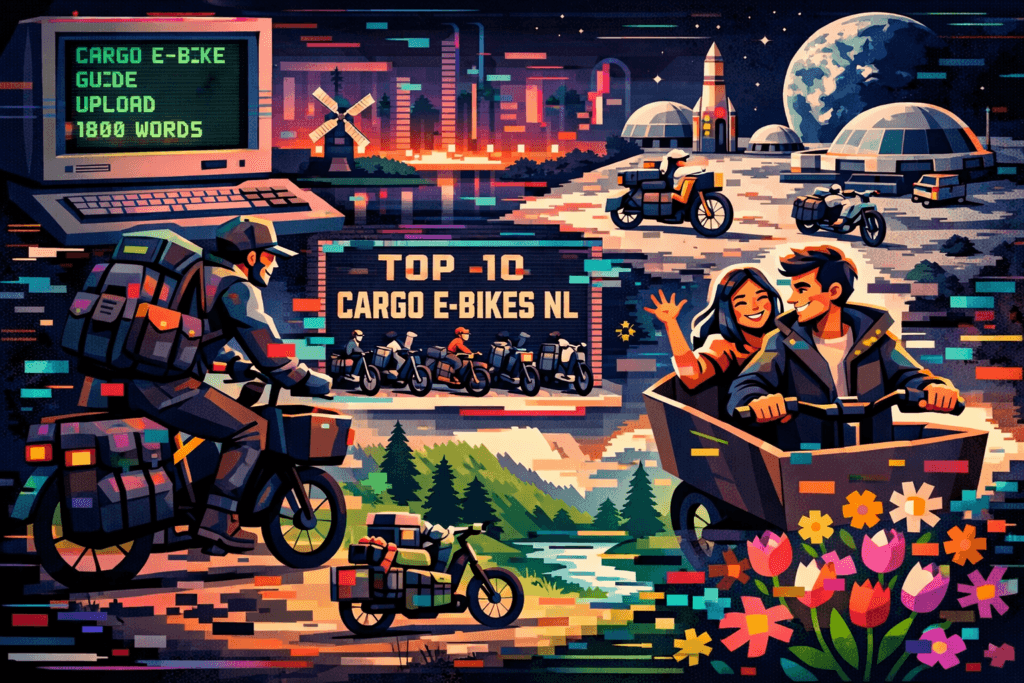
Listen. The rain is hitting the cobblestones again. Rotterdam docks blink in the fog. You hear it before you see it — the low electric hum of something big rolling through the narrow arteries of the city, effortlessly swallowing grocery runs, children, bicycles, amplifiers, and one very patient girlfriend who swore she’d never sit in a cargo box again. She’s sitting in the cargo box again. The cargo e-bike doesn’t care. It has already won.
We are living inside a neo-genesis of urban transport. Somewhere between a moon base logistics dream and a flower-power Woodstock wagon retrofitted with lithium cells and torque sensors, the cargo e-bike exists. It is absurd. It is practical. It is, statistically, the only vehicle that can haul 100kg of camping gear through the Veluwe forest trails while simultaneously playing early-90s game soundtracks from a Bluetooth speaker bungee-corded to the handlebar bag.
Pop the hood — metaphorically, because cargo bikes don’t have hoods, they have vast flat decks and front boxes the size of small apartments. What powers these rolling warehouses is a mid-drive or hub-drive electric motor typically outputting between 250W and 750W depending on whether your use case is “gentle morning school run” or “hauling three surfboards plus wetsuit plus existential dread.”
The motor talks to a torque sensor — your legs push, the motor listens, amplifies, harmonizes. It’s less “engine” and more symbiotic digital companion. Systems like Bosch Cargo Line, Shimano EP8, and Bafang M620 dominate the market, each with their own personality: Bosch is the reliable old-school gamer who knows every secret level; Shimano is the technical speedrunner who never wastes a watt; Bafang is the modding-scene wildcard who will overclock anything if you ask nicely.
SYSTEM:: TORQUE_SENSOR — ACTIVE [87Nm detected]
SYSTEM:: DISPLAY_UNIT — Bosch Kiox 300
SYSTEM:: ASSIST_LEVEL — ECO → TURBO [switching]
SYSTEM:: RANGE_ESTIMATE — 73km remaining
SYSTEM:: CARGO_WEIGHT — 94kg detected… acceptable.
SYSTEM:: GIRLFRIEND_MODULE — patience level: 62% ↓ recommend destination ETA
The battery is the beating neon heart of the operation. Most cargo e-bikes roll with 500Wh to 1000Wh cells — some flagship beasts mount dual battery systems that push 1400Wh and beyond, enough to take you from Amsterdam to the German border without charging, assuming you’re riding level terrain and not fighting a North Sea headwind. (You will be fighting a North Sea headwind. This is the Netherlands.)
Samsung and Panasonic 21700 cells are the workhorses of choice — proven chemistry, stable discharge curves, and tolerant of the kind of rough urban reality that involves curbs, canal bridges, and that one cobblestone stretch on the Prinsengracht that vibrates everything loose. Charging times range from 4 to 8 hours standard, or 2 to 3 hours with dual-charger setups. Fast-charge technology is entering the cargo space — some 2025 models accept up to 6A input — but thermal management remains the limiting variable. You cannot rush a battery. The battery is a monk. The battery knows things.
Battery life cycles: expect 800–1200 full charge cycles before meaningful capacity degradation — that’s 5 to 8 years of daily use for the average cargo warrior. Replacements are dropping in price every fiscal quarter. By the time your first pack fades, a better one will cost half as much. This is the electric accordion of economics playing in your favor, finally.
“THE CARGO E-BIKE IS NOT TRANSPORTATION. IT IS A PHILOSOPHY. A CONFESSION. A DECLARATION THAT YOU HAVE DECIDED TO CARRY MORE LIFE WITH YOU.”
Netherlands field data. Prices are approximate 2025 market rates. Dutch bike culture doesn’t mess around — these are the cargo rigs that dominate the streets of Amsterdam, Utrecht, Groningen, and every village in between.
-
Riese & Müller Packster 70The luxury flagship. Bosch Cargo Line CX motor. Dual battery option reaching 1000Wh. Front box swallows two children, a week of groceries, and your entire will to own a car. German engineering at its most unapologetically thorough.~€8.500
-
Urban Arrow FamilyAmsterdam’s native son. The most common sight on Dutch school runs. Bosch Performance Line CX. EPP foam box. Weatherproof cover options. Rain canopy turns it into a cozy submarine for small passengers. The gold standard of family cargo.~€5.999
-
Babboe Curve Mountain EDutch-built. Three wheels. Incredibly stable. Bosch Performance motor. The wooden box ages like a ship’s hull and smells like adventure. Handles NL canal paths, cobblestone centres, and that very specific gradient of the Arnhem ring road.~€4.799
-
Tern GSD S10Compact long-tail. Folds. Fits in lifts. Bosch CX motor. Up to 200kg total capacity. Two adults or massive loads. The transformer of the cargo e-bike world — suburban ninja, city phantom, weekend warrior. Loved by cyclists who refuse to compromise.~€5.299
-
Gazelle Makki LoadGazelle is Dutch cycling royalty. The Makki Load is their cargo entry point — Bosch Active Line Plus, front-loading box, clean geometry. More affordable gateway into the cargo world with the build quality and reliability you’d expect from a century-old brand.~€3.999
-
Bullitt E by Larry vs HarryThe courier’s weapon. Low-slung Danish speed machine. Shimano EP8. Optional 750W motor for speed pedelec. Long platform. Insane handling. Loved by delivery riders, hated by car drivers who can’t figure out why it’s faster than them in traffic.~€5.800
-
Yuba Spicy CurryLong-tail California attitude meeting Dutch pragmatism. Shimano Steps E8000. Holds 180kg. Racks, side panels, running boards for kid passengers. Modular and upgradeable. The open-source spirit of cargo bikes — customize your loadout endlessly.~€4.200
-
Veloretti Cargo TwoAmsterdam design studio meets cargo function. Mid-drive motor, clean minimal aesthetic that looks like it was designed in a brutalist gallery. Smaller front box is perfect for the cargo-curious who don’t yet need to transport a full IKEA run.~€3.499
-
CERO ONEModular cargo system. Interchangeable front decks — passenger box, flat deck, utility rack. Bafang motor. Built for the cyclist who can’t decide what kind of cargo cyclist they are. The answer is: all of them, simultaneously, on a Tuesday.~€4.600
-
Douze Cycles G2EFrench engineering entering Dutch territory. Premium welds. Front cargo cell is architectural in its precision. Shimano EP8. One of those bikes that makes pedestrians stop and photograph it. For the cargo cyclist who considers aesthetics a load-bearing element.~€6.200
The streets are changing. Neo genesis isn’t a metaphor — it’s happening at 25km/h in front of school gates, along river paths, through forest service roads, down the neon-lit corridors of night-city logistics. The cargo e-bike is not a trend. It is not a gadget. It is not a statement. It is a renegotiation of what daily life looks like when you remove the assumption that movement requires burning something.
From the moon base imaginations of retrofuturism to the flower-thick meadows of a Dutch summer, the cargo e-bike exists at the intersection of every beautiful idea humans have had about transport: community, efficiency, joy, capacity, silence, and the deeply satisfying hum of torque doing what torque was born to do.
Your backpack is loaded. Your panels are strapped. The battery reads 94%. Somewhere in the front box, packed between a sleeping bag and a vintage Game Boy, is the version of yourself that decided to ride instead of drive. She’s already smiling. The woods are close. The river is closer. The motor is ready.
EVSunrise:: SIGNAL_STRENGTH — ████████░░ 82%
EVSunrise:: CARGO_CULT_INITIATED — true
EVSunrise:: NEXT_TRANSMISSION — e-cargo_for_wanderers.html
EVSunrise:: SIGNING OFF // STAY CHARGED // STAY WEIRD
> _