
Fordlândia Reimagined: Electric Dreams in the Forgotten City of the Amazon
In the late 1920s, industrialist Henry Ford attempted something no entrepreneur had ever dared: he tried to transplant a piece of American industrial civilization into the heart of the Amazon rainforest. The result was Fordlândia—a planned company town built by Ford Motor Company along the Tapajós River in Brazil.
Today, the ruins of Ford’s grand experiment still stand among the trees. The rusted water tower rises above the canopy, abandoned factories sleep under vines, and wooden American-style houses slowly dissolve into tropical humidity. But what if the story did not end as a cautionary tale? What if Fordlândia—once the ultimate symbol of industrial ambition—became a secret laboratory for the future of electric mobility?
Imagine a hidden innovation hub in the jungle, where advanced electric vehicles and ecological engineering merge with the Amazon’s biodiversity. The ghosts of Ford’s industrial utopia might yet inspire a new era of sustainable transportation.
The Birth of a Jungle City
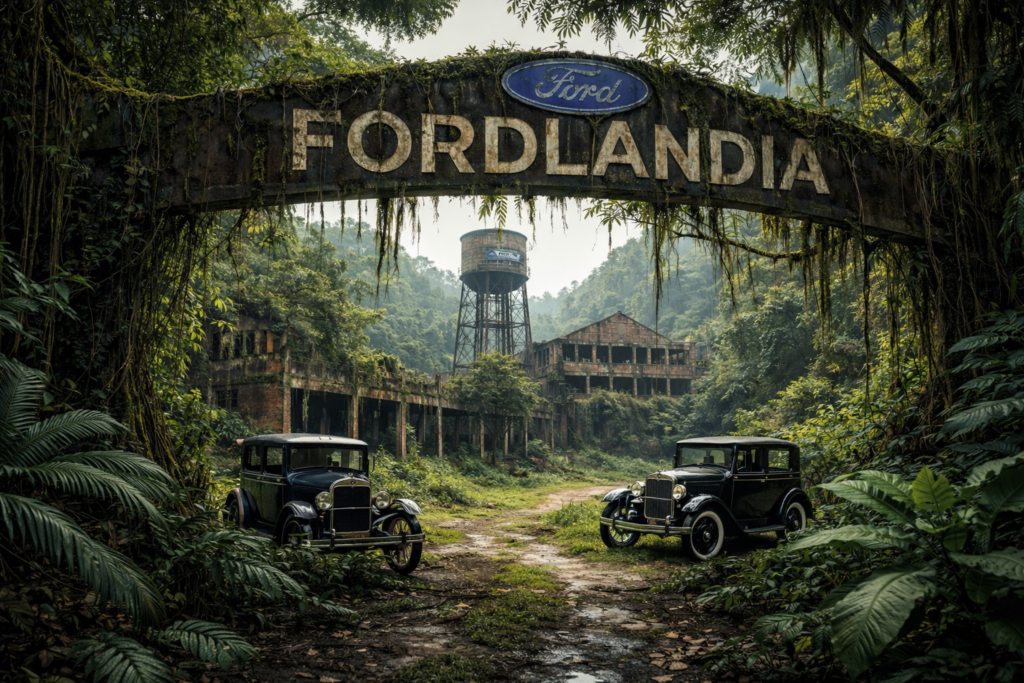
The origins of Fordlândia lie in the global politics of rubber. During the early 20th century, rubber was essential for tires, machinery, and industrial equipment. By the 1920s, most rubber plantations were controlled by European colonial interests in Southeast Asia, creating a near monopoly that worried American manufacturers. Henry Ford decided to break that dependence.
In 1927 he negotiated with the Brazilian government for roughly 2.5 million acres of Amazon rainforest along the Tapajós River. The plan was bold: build a vast rubber plantation and a fully modern American town to house workers and managers.
Within a few years, cargo ships arrived loaded with everything from water towers and machinery to prefabricated houses and hospital equipment. Streets were laid out in geometric grids. The settlement included schools, a hospital, a library, swimming pools, and even a golf course—an American suburb carved from rainforest wilderness.
Fordlândia was meant to host up to 10,000 residents and supply rubber for millions of automobiles rolling off Ford assembly lines in Detroit. But the jungle had its own plans.
When the Forest Fought Back
Nature quickly turned the dream into a struggle. Rubber trees planted in orderly rows—efficient by industrial standards—proved vulnerable in the Amazon ecosystem. In the wild, rubber trees grow scattered through dense forests, which protects them from pests and fungal diseases. On Ford’s plantations, however, the tightly packed trees became easy targets for blight and insects.
Meanwhile, workers battled malaria, yellow fever, and the relentless heat. The project faced logistical nightmares: there were no roads, only river access. Clearing the jungle was slow and dangerous work.
Ford’s attempt to impose American cultural norms only intensified tensions. Alcohol was banned, cafeterias served unfamiliar food, and workers were expected to follow strict routines and leisure activities modeled after Midwestern life.
In 1930, frustrations erupted in a violent uprising known as the “canteen revolt,” when workers smashed equipment and forced American managers to flee the town. The plantation never recovered from the ecological and social challenges.
Ultimately, Ford abandoned the project. In 1945, the company sold the entire operation back to the Brazilian government at a massive loss—having produced almost no usable rubber.
Yet Fordlândia did not disappear completely. A few thousand residents still live there today, surrounded by relics of one of the 20th century’s most ambitious industrial experiments.
A Hidden Laboratory in the Rainforest
Now imagine the story taking a different direction in the 21st century.
Deep in the Amazon basin, far from highways and urban centers, Fordlândia becomes an unlikely research site for the next generation of electric vehicles. The abandoned factories and warehouses—once built for rubber processing—are reborn as laboratories powered by solar arrays and river micro-hydroelectric turbines.
The location offers something unique: a natural proving ground. The rainforest environment is one of the harshest testing landscapes on Earth. Heat, humidity, mud, and unpredictable terrain challenge every mechanical system.
For engineers designing electric vehicles, these conditions reveal weaknesses faster than any controlled laboratory.
Electric drivetrains, battery cooling systems, and regenerative braking algorithms must adapt to steep jungle roads, river crossings, and high-moisture climates. If technology survives here, it can survive anywhere.
Electric Mobility Meets the Jungle
Modern electric vehicles rely on technologies unimaginable during Ford’s era. Lightweight battery packs, AI-assisted navigation, and modular drive systems allow vehicles to function efficiently in remote environments.
Inside the reimagined Fordlândia research center, engineers experiment with three categories of electric mobility.
1. Jungle Utility EVs
These vehicles resemble compact off-road trucks designed for forest research and conservation. Their electric motors provide instant torque, ideal for steep trails and muddy terrain.
Solar-integrated body panels help extend range during long expeditions. Meanwhile, modular battery packs can be swapped quickly in remote stations along riverbanks.
Instead of noisy combustion engines disturbing wildlife, these vehicles move almost silently through the forest.
2. Amphibious Electric Transport
The Amazon basin is a world of rivers. Engineers experiment with amphibious EVs capable of driving through shallow floodplains and navigating waterways.
Magnetic-sealed battery housings protect electrical systems from water intrusion. Lightweight composite hulls allow vehicles to float and transition smoothly from land to river.
These machines could transform logistics for remote communities, delivering medical supplies and equipment without relying on diesel boats.
3. Autonomous Eco-Mapping Vehicles
Perhaps the most futuristic vehicles developed in the jungle laboratory are autonomous research platforms.
Equipped with lidar scanners, environmental sensors, and AI navigation software, these electric vehicles map biodiversity, monitor forest health, and track illegal logging.
Instead of satellite observation alone, fleets of autonomous EVs gather high-resolution environmental data directly from the forest floor.
In this way, transportation technology becomes a tool for conservation.
New Battery Technologies in Isolation
One of the greatest advantages of a remote research site like Fordlândia is its isolation. Engineers can experiment with emerging battery technologies without interference from urban infrastructure constraints.
Among the most promising developments are:
Solid-state batteries – offering greater energy density and reduced fire risk compared to traditional lithium-ion cells.
Bio-derived battery materials – utilizing plant-based polymers inspired by rainforest chemistry.
Self-healing battery coatings – developed to withstand the extreme humidity and microbial activity of tropical ecosystems.
Ironically, the rainforest that once defeated Ford’s rubber plantations now inspires entirely new materials science breakthroughs.
Sustainable Manufacturing in the Forest
Unlike the industrial megafactories of the 20th century, the new Fordlândia operates as a distributed micro-manufacturing ecosystem.
Small production workshops powered by renewable energy fabricate components using advanced 3D printing and robotic assembly.
Local communities participate in the production chain, building vehicle frames, assembling battery modules, and maintaining testing fleets.
The concept reflects a broader shift in automotive manufacturing—from centralized mass production to decentralized innovation networks.
In a poetic twist, the company town model that once defined Fordlândia evolves into a collaborative technology village.
A Symbol of Reinvention
The original Fordlândia represented industrial ambition colliding with ecological reality. It was an attempt to reshape the Amazon according to the logic of assembly lines and factory towns.
The new vision reverses that logic.
Instead of forcing the jungle to adapt to industry, engineers design technology that adapts to the jungle.
Electric vehicles become lighter, quieter, and more environmentally integrated. Research focuses not only on mobility but also on sustainability, biodiversity monitoring, and resilient infrastructure.
The Amazon becomes a partner in innovation rather than an obstacle.
The Legacy of Ford’s Dream
Although the original project failed, its legacy remains powerful.
Fordlândia demonstrated both the potential and the limits of industrial utopianism. It showed how technology, culture, and ecology intersect in complex ways.
Nearly a century later, the same location could symbolize a new philosophy of engineering—one that respects the environment while pushing technological boundaries.
Where rusting machinery once stood, electric vehicles might quietly charge under solar canopies.
Where abandoned streets disappear into jungle vines, autonomous research rovers could map the forest’s hidden ecosystems.
And where the ghost of an unfinished industrial dream still lingers, a new future for sustainable mobility could emerge—hidden deep within the Amazon.