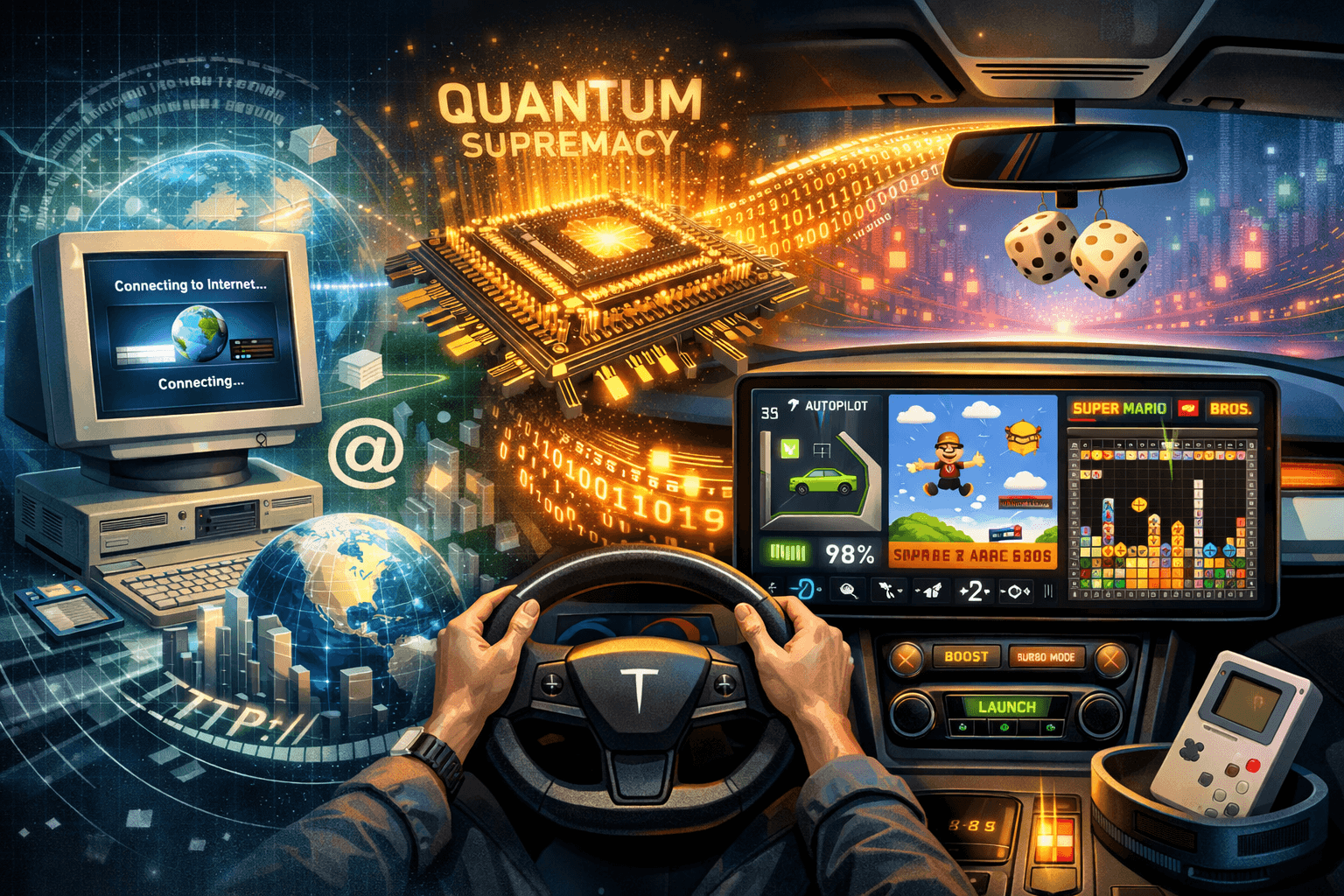
Dashboard Dreams: How the Screen in Your EV Became the Console You Always Wanted
Dashboard Dreams: How the Screen in Your EV Became the Console You Always Wanted
From dial-up modem screeches to 17-inch touchscreens doing 0-to-60 in 3.1 seconds — a nostalgic, slightly nerdy history of digital displays, teenage bedrooms, and the strange road that led pixels straight into your steering wheel.
There’s a specific kind of memory that lives somewhere between your hands and your chest. It’s the memory of staring into a screen — not anxiously, not productively — just staring. Absorbing. The CRT monitor’s slight hum. The way the desktop background felt like a portal to somewhere better. The low resolution of everything back then somehow making it feel more real, not less. If you grew up in the nineties or early 2000s, screens were magic before they were furniture. And now, somehow, that magic has found its way into the dashboard of an electric car.
The story of how we got here is messier and weirder and more human than any product roadmap could contain. It cuts through arcades and dorm rooms, through Windows 95 boot sounds and SNES cartridge wobbles, through Napster and Limewire and sites with visitor counters ticking up like slot machines. It is, at its core, a story about what a generation of young people wanted from a glowing rectangle — and what happens when that glowing rectangle eventually shows up doing 70 mph on the highway.
The First Screen That Felt Like Yours
Let’s be honest about what that first screen actually was. For most kids born between 1985 and 1998, it was either a TV commandeered for game consoles or the family computer wedged in a corner of the living room, rationed like a household resource. The internet was a sound — that blistering 56k handshake, a dial-up mating call that meant you were entering somewhere else. Pages loaded in strips, top to bottom, like a photograph developing in a darkroom. You waited. You didn’t refresh. Waiting was part of it.
C:\> AOL.exe
Connecting to AOL…
Welcome. You’ve got mail.
// 14.4 kbps · estimated time: 40 mins · status: worth it
The interface of early internet was designed by necessity, not by UX teams. GeoCities pages blinked. Guestbooks were signed. Forums used nested tables and rainbow text. There was a rawness to it — handmade quality, like zines or mixtapes. Every weird site felt authored by an actual weird person, not a content strategy. You could feel the personality radiating off a page like static electricity. The internet, in its teenage years, behaved exactly like a teenager: chaotic, earnest, slightly embarrassing, unforgettable.
// Meanwhile, in Cars
Meanwhile, cars were essentially analog furniture. The dashboard of a 1999 sedan was a masterpiece of mechanical commitment: physical dials for everything, FM radio with preset buttons you had to physically press until they clicked, a cassette deck even after CDs existed. The most “digital” thing in most family cars was a small LCD display showing the clock and maybe the outside temperature, rendered in pixel-segments the color of old mustard. Nobody called it an infotainment system. It was just the clock.
“The first car screens were apologies — tiny windows into a functionality that barely needed a window at all.”
The first real attempt at digital dashboards came in the 1980s. Cadillac’s 1986 Eldorado had a digital instrument cluster that felt wildly futuristic — numbers instead of needles, a readout instead of a gauge. It promptly became one of the most complained-about features of the decade. Drivers didn’t trust numbers. They trusted needles. Analog felt honest. Digital felt like a gimmick trying to distract from the fact that it was a gimmick.
The Console Generation Grows Up
But the kids growing up with those “gimmicks” in the background of their childhoods — they were building fluency. Every hour logged on a Game Boy was interface literacy being installed. Every menu navigated on a PlayStation was muscle memory being written. Nintendo understood something that car manufacturers didn’t yet: the screen wasn’t a tool, it was a relationship. You didn’t use a SNES. You inhabited it.
College dorms in the early 2000s were the real proving grounds. A laptop was identity. The desktop wallpaper you chose, the away message you posted on AIM, the skin you put on your Winamp player — these were expressions of self as much as the band t-shirt on your back. Screen real estate was finite and precious and deeply personal. You’d spend 45 minutes configuring a media player that took up 6% of your screen because those 6% were yours. The software had to feel like you.
And then came the iPhone. 2007. The moment that rewired the entire grammar of human-screen interaction. Suddenly, the touchscreen wasn’t a sci-fi novelty — it was the obvious, natural, why-did-we-ever-use-anything-else way to interact with information. The pinch, the swipe, the tap: a new physical vocabulary that a generation of kids learned before they learned cursive. The screen became a direct extension of the hand, and from that moment on, every other interface in the world started feeling broken by comparison.
Tesla Walks In and Changes the Conversation
When Tesla released the Model S in 2012, it did something that felt almost aggressive: it put a 17-inch touchscreen in the center of the dashboard and called it the infotainment system. It was enormous. It was landscape-oriented. It controlled almost everything — HVAC, navigation, media, charging settings, even opening the glovebox. Critics called it a distraction. Early adopters called it a revelation. The automotive press struggled to find a frame of reference, eventually landing on “iPad on wheels,” which was both accurate and slightly condescending, in the way that comparisons to consumer devices always are when applied to industrial ones.
But here’s what those reviews missed: for anyone who’d grown up living inside screens, the Tesla dashboard wasn’t strange at all. It was familiar. It was the thing they’d been waiting for cars to become. The same generation that had configured their desktop to feel like home, that had modded their gaming consoles, that had spent hours skinning their browsers — they were now buying cars. And they wanted their cars to feel like something they could inhabit, not just operate.
1986 → Cadillac digital dash · 0 touchpoints · 100% distrust
1994 → Pioneer DEH-88 · first CD head unit w/ LCD
2001 → BMW iDrive · knob-controlled UI · universally hated
2007 → iPhone launches · touch grammar changes everything
2012 → Tesla Model S · 17″ touchscreen · the pivot point
2019 → OTA updates · cars become software products
2024 → ADAS HUDs · AR overlays · the windshield as display
Pixels, Patches, and Over-the-Air Everything
What truly distinguished the EV screen from every car screen before it wasn’t the resolution or the size — it was the fact that it could change. Over-the-air software updates turned cars into a new category of object: a product that improved while you owned it. Your 2013 Model S could wake up in 2019 with features it didn’t ship with. Navigation got sharper. Games got added. The UI got refined. This was the operating logic of software applied to something that weighed 4,000 pounds and went on the highway.
This was deeply weird in the best possible way. It was the same logic that made gaming consoles exciting: the platform itself was a promise, not just a product. You bought a PlayStation not just for the launch titles but for what it might become. Every EV with an update server is running the same bet. The car you drive in 2026 might be meaningfully better than the car you drove off the lot — not because you tuned the engine, but because someone in a building somewhere pushed a commit to a git repository and now your regenerative braking algorithm is smoother. Welcome to software. Please enjoy your sedan.
The Dashboard as Mirror
There’s something quietly profound happening when you look at the center console of a modern EV. It’s not just a screen showing you speed and range and which podcast you queued up. It’s the full arc of a generation’s relationship with technology, compressed into a slab of glass and silicon behind the steering wheel. The teenagers who stared into low-resolution monitors in 1998, feeling like the screen was a door to somewhere bigger — those same people, now in their 30s and 40s, are looking at a 15-inch OLED display rendering real-time traffic in satellite view while the car manages its own lane position. The door got bigger. It also started driving.
And the newest generation? They’ve never known cars without screens. For a 17-year-old learning to drive in 2026, a physical dial is the novelty. A button you have to press with actual mechanical click-back is retro. The fluency has fully flipped. What was once familiar to the young and alien to the old is now alien to the young in a different direction — the analogue past becomes the obscure reference, the thing you have to explain, like dial-up, like a floppy disk, like a TV remote with physical channel buttons that went up only in order.
“The car you drive in 2026 might be better than the car you bought — not because you tuned anything, but because someone pushed a commit and your braking got smarter overnight.”
What We Actually Wanted All Along
Maybe the real story isn’t about technology at all. Maybe it’s about what young people have always wanted from the screens in their lives: to feel like the machine understood them. The old internet was powerful because it felt personal — because someone chose that blinking GIF, because someone typed that forum post at 2am in a dorm room with the kind of sincerity you only have when you don’t yet know what’s embarrassing. The GameBoy was powerful because it fit in a pocket and went everywhere, because it was yours in a way that the living room TV never was. The iPhone was powerful because it collapsed every screen need into one pane of glass that was always with you.
The EV dashboard is the latest version of this. It’s an attempt — clunky in some ways, genuinely beautiful in others — to make the car feel like it belongs to you the way your phone does. To make it a system you can configure and personalize, that learns your presets, that updates and evolves, that plays music and games and runs apps and remembers where you park. It is, in the plainest terms, a computer you drive. And if you’re a certain age, that still feels like magic, even though the CRT hum is gone and the pages load instantly now and nobody’s got a dial-up connection anymore.
Somewhere between the screech of a 56k modem and the whisper of an electric motor, the screen won. It didn’t just win the living room or the pocket. It won the road. And for a generation that grew up staring into glowing rectangles with wide eyes and nowhere else to be — honestly, it makes perfect sense.
Dude!