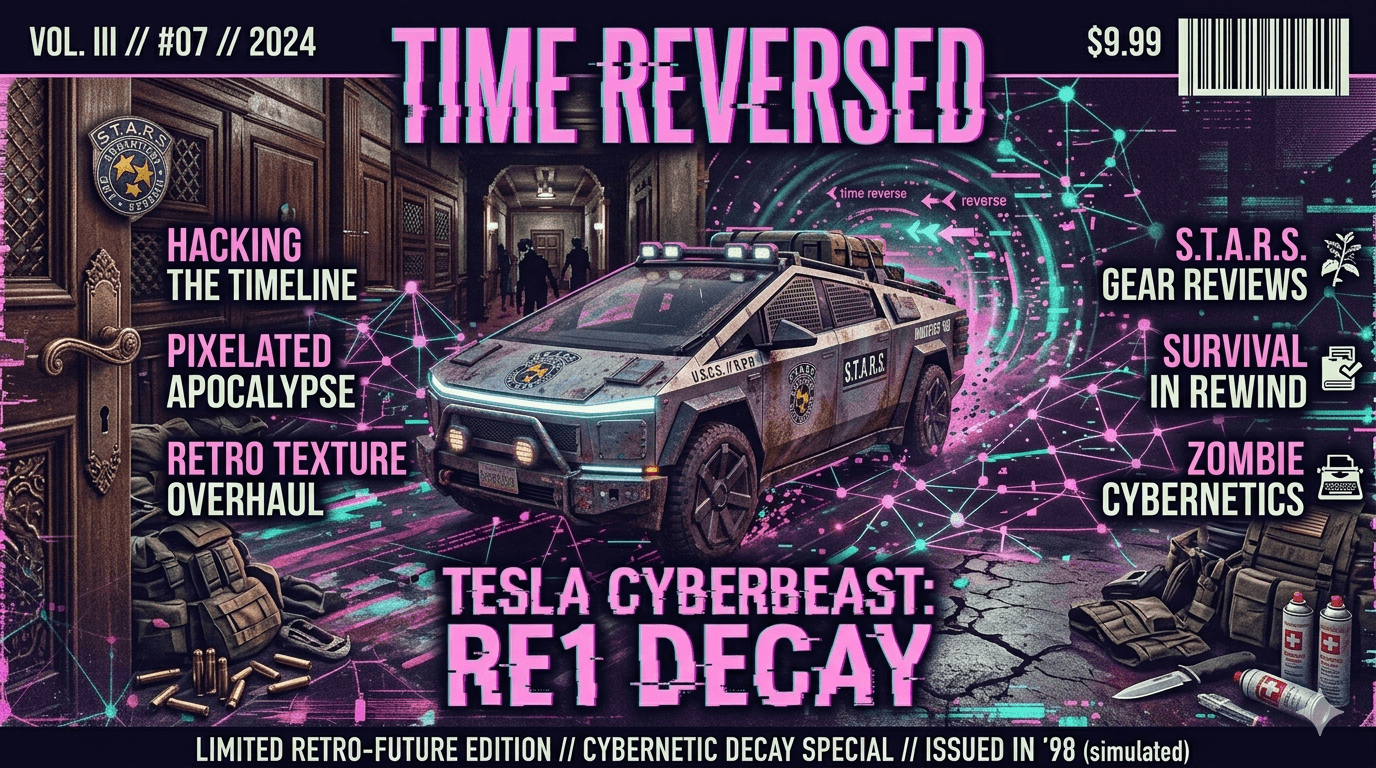
5 Native Arklay Modifications for Tesla CyberTruck
5 NATIVE ARKLAY
MODIFICATIONS
FOR THE TESLA
TRUCK
GROUND CONTROL TRANSMISSION — LUNAR ORBIT — SEPT 28 1998 — 22:14 UTC
Five hardware and software modifications discovered in the wreckage of the Arklay Valley EV infrastructure — now transmitted live from a TeslaTruck in lunar orbit, because the Raccoon City ground relay went dark at 21:44 and this is the only signal still reaching the surface
ALT: 384,400 KM
PERIOD: 27.3 DAYS
SIGNAL: ACTIVE
DASH: ONLINE
RACCOON CITY: OFFLINE
Ground Control to Arklay-1. We are transmitting on all frequencies. The Raccoon City mesh network went dark forty-three minutes ago and the only signal still reaching the surface is bouncing off a TeslaTruck parked in lunar orbit at 384,400 kilometres. The irony is not lost on us. The city that couldn’t keep its EV charging bays online is now receiving its final broadcast from a vehicle in deep space. The transmission contains five modifications. They were developed in Arklay Valley over the summer of 1998, mostly by people who are no longer available for follow-up questions. We are sending them now because the dash screen is the last uplink we have. Copy, Arklay-1.
The TeslaTruck’s dash screen — when operated in orbital relay mode — functions as a bidirectional data terminal. What the driver sees is a live feed from Ground Control: maps, telemetry, modification specs, and the occasional personal message from people who have been waiting three months to reach someone in the Arklay Valley. What Ground Control sees is everything the truck’s sensors record. In lunar orbit, those sensors are recording the dark side of the Earth over Raccoon City, a region that has recently become very quiet in a way that correlates precisely with Rebecca Chambers’ last transmission at 21:44.
The original Arklay modification — developed after Rebecca Chambers identified that the standard TeslaTruck cabin air monitoring system was calibrated for urban pollution and not for mutagenic airborne compound vectors. The mod replaces the factory air quality sensor with a modified unit that logs molecular markers at the compound level, transmitting real-time atmospheric data to the dash screen as a colour-coded overlay: green for clear, amber for anomalous, red for evacuate immediately.
The sensor was never officially approved for production. It was submitted to the Raccoon City municipal health board in September 1998 and acknowledged with an automated response. The modification was installed in three vehicles in the valley, all of which are now providing very specific atmospheric data to Ground Control’s receiver array. The data from those vehicles was, in retrospect, the most accurate real-time information about what was happening in Raccoon City that evening.
The charging bay problem that occupied Barry Burton’s entire September was, at its root, an infrastructure dependency problem. The TeslaTruck’s factory charge management system requires a functioning city mesh connection to negotiate charging rates, authenticate payment, and log sessions. When the mesh goes down — as Raccoon City’s sector 7 nodes did progressively throughout September 28 — the truck cannot charge even from a functioning physical socket.
The Arklay Mesh-Independent Charging Protocol bypasses this entirely. The mod installs a hardwired direct-current fallback layer that negotiates charging from any 240V source without network authentication. The dash screen displays a manual override panel showing raw voltage, amperage, and estimated charge time with no server handshake required. It was tested extensively using the Arklay Service Station’s backup generator. It was also, technically, the reason Derek from flat 4B was able to charge a Mini Cooper in his living room at 44% efficiency. The mod works. The circuit still trips. Those are separate problems.
When the Raccoon City mesh network started dropping nodes on September 28, the first thing to fail was the EV dash chat — the system that Jill Valentine was using to message Rebecca Chambers, that Rebecca was using as her only secure channel, that John Donahue was using to tell strangers on the internet that he was locked inside a CyberTruck watching the street. The city’s EVs went communicatively dark at 21:44 simultaneously.
The Dead-Zone Mesh Relay modification turns each TeslaTruck into an autonomous mesh node. When the city network drops, the trucks automatically begin peer-to-peer bridging at 900MHz, forming a local mesh that propagates through any vehicles within 2km. The dash screen switches from the city network indicator to a local mesh map, showing every other relay-equipped vehicle in range as a glowing node. The network the city failed to maintain, the vehicles rebuild themselves.
This is the John Donahue modification. Named informally after the man who spent ninety minutes locked inside a CyberTruck-adjacent vehicle on Broad Street, communicating with strangers through the dash screen chat interface, watching something approach through the windshield, going AWAY, and returning at 22:01 with measured thoughts about mechanical engineering philosophy.
The factory electric door lock system on the affected vehicles used a fully software-controlled latch with no mechanical bypass — the lock motor and the internal release handle were on the same circuit, meaning a software lockdown trapped the occupant completely. The Arklay Mechanical Override Mandate installs a hardwired physical T-bar cable release running from inside the door panel directly to the latch mechanism, bypassing all electronics entirely. The dash screen displays a bright red override indicator at all times. It cannot be disabled. It cannot be patched out. It is a metal cable. John Donahue personally funded the patent filing for this modification in 1999 and has a framed copy in his Portland home.
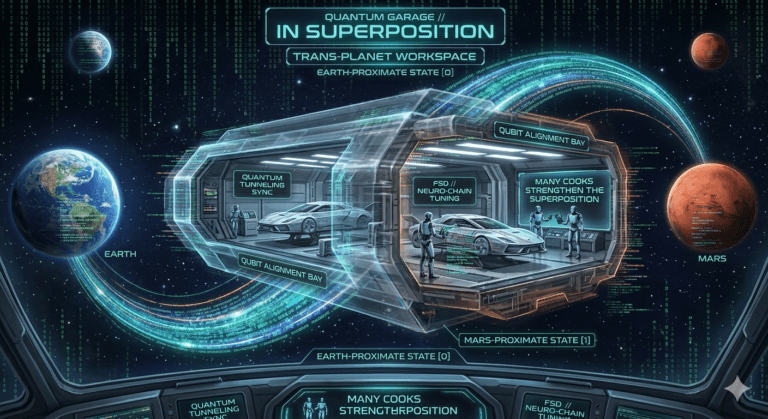
The fifth modification is the one that makes this transmission possible. When all ground-based relay nodes are offline — when the city mesh is dark, when the precinct server has gone silent, when the EV charging bays have stopped responding and the pharmaceutical company’s router is apparently having a very long outage — the TeslaTruck dash screen is capable of switching to satellite uplink mode via lunar relay, communicating directly with any orbital or lunar-surface node operating on the 2.4GHz spectrum.
This is not a factory feature. It was developed by Rebecca Chambers, aged 18, over three evenings in August 1998 using the S.T.A.R.S. medical vehicle’s dashboard terminal and a radio astronomy textbook borrowed from the Raccoon City public library. The modification requires no hardware beyond a firmware patch and a correctly configured antenna array. The antenna array is a modified coat hanger fitted to the truck’s roof panel by Barry Burton, who remains the only member of S.T.A.R.S. Alpha Team with the practical skills to implement Rebecca’s theoretical work in under four hours.
When the ground goes dark, the dash goes up. The signal bounces off the lunar node, returns to Ground Control, and from there reaches anywhere on Earth with a functioning receiver. The modification turns the TeslaTruck dash screen from a local communication device into a planetary broadcast terminal. It is, without question, the most significant piece of automotive software ever written on a police precinct computer after hours by a teenager who was also corresponding with documentary filmmakers about battery chemistry at the time.
BARRY IS STILL ASKING ABOUT THE CHARGING BAY